Why does reputation management matter more for movers than almost any other local business?
Because a mover only gets one shot per customer, and the stakes are personal property, not a $12 lunch order. BrightLocal's 2026 Local Consumer Review Survey — a fresh panel of 1,002 US adults, published February 2026 — found 97% of consumers read reviews before choosing a local business, and 41% now say they "always" read reviews when browsing, up from 29% the year before (BrightLocal Local Consumer Review Survey 2026). For a moving company, that review is doing double duty: it's proof you show up on time, and proof you don't lose or break what a family has spent years accumulating. No other local-service category carries that combination of trust and irreversibility in a single transaction.
The problem most moving companies have isn't bad service. It's that they treat reviews as something that happens to them instead of something they run. This guide covers what actually moves the needle in 2026: how many reviews you need, how fast you need to respond, what kind of response works, and how to turn the whole cycle into a repeatable part of your dispatch and follow-up process instead of a monthly scramble.
How many Google reviews does a moving company actually need?
More than you probably think, and the bar is rising. BrightLocal's 2026 data shows 47% of consumers won't use a business with fewer than 20 reviews, and only 9% will consider one with five or fewer (BrightLocal, 2026). Twenty reviews sounds achievable until you realize the same survey found consumers also want those reviews recent: 74% only give weight to reviews written in the last three months, and 32% only trust reviews from the last two weeks — nearly double the 20% who said the same in 2025.
Put those two numbers together and the real target isn't "get to 20 reviews and relax." It's "maintain a rolling window of 15-20+ reviews from the last 90 days, indefinitely." That's a volume problem, not a one-time campaign. A company doing 40 moves a month needs a review-request system that fires automatically on every completed job, because manually remembering to ask after a long moving day is exactly the kind of task that falls off a busy dispatcher's list.
Star rating matters too, and the bar there is rising as well. The same survey found 31% of consumers will only use a business with 4.5+ stars, up from prior years, with the overall trend line for minimum acceptable rating climbing year over year (BrightLocal, 2026). A 4.2-star mover with 60 reviews is now losing a meaningful slice of shoppers who simply won't scroll past the star icon.
That star rating also feeds a business metric worth tracking alongside it: conversion rate. A weak rating doesn't just cost you clicks in the local pack, it drags down how many of those clicks turn into booked estimates once someone lands on your site.
What actually makes a review convincing to a potential customer?
Not length, and not a single 5-star outlier. BrightLocal asked consumers to rank the factors that make a review trustworthy, and the results reorder a lot of conventional wisdom:
| Rank | Factor | % who said it matters |
|---|---|---|
| 1 | Backed up by other reviews with similar sentiment | 56% |
| 2 | Describes a positive experience | 46% |
| 3 | Posted within the last month | 44% |
| 4 | Has a high star rating | 42% |
| 5 | Business owner responded to the review | 37% |
| 6 (tie) | Good spelling/grammar | 36% |
| 6 (tie) | Has an appealing photo or video attached | 36% |
(Source: BrightLocal Local Consumer Review Survey 2026)
Notice what's near the bottom: a long, detailed review ranks dead last at 26%. Consumers don't want an essay. They want consistency — the same story told by multiple different people — and they want it recent. That changes what you should actually ask customers for. Instead of "please leave us a detailed review," the better ask is simpler and faster to complete: "how did the move go — on time, careful with your things, would you use us again?" Short answers that repeat the same themes across dozens of reviews build more trust than one perfect paragraph.
There's a technical detail here that matters if your website displays reviews directly: Google's own developer documentation now recommends only publishing ratings that come with an actual comment and the reviewer's name attached, rather than a bare star score with no context (Search Engine Roundtable, "Google Prefers Review Ratings To Contain Author Name & Comments"). A review widget that only shows star icons without the actual customer's words is both less convincing to shoppers and worse-aligned with how Google wants review content displayed.
How fast do you actually need to respond to reviews?
Faster than most moving companies think, and the expectation jumped hard in the last year. In BrightLocal's 2026 data, 19% of consumers now expect a same-day response to their review — up from just 6% the year before — and 32% expect a response by the next day, up from 18% (BrightLocal, 2026). In total, 81% expect a reply within a week. And responding matters regardless of star rating: 89% of consumers expect business owners to respond to reviews at all, and 80% say they're more likely to use a business that responds to every review, compared to just 45-47% for businesses that only respond to positive or only to negative reviews.
Here's the part that should change how you write responses, not just how fast you send them: 50% of consumers say a generic, templated reply makes them less likely to choose that business. Copy-pasting "Thank you for your feedback!" under every review is close to as damaging as not responding at all. The fix isn't complicated — reference something specific from the actual move (the neighborhood, the day of the week, the item the crew was careful with) so the response reads like it was written by a person who read the review, not a bot that fired on a five-star trigger.
Negative reviews carry the highest stakes and the shortest window. A slow or defensive response to a bad review is read by every future customer who Googles your name before booking, not just the person who wrote it. The move that works: acknowledge specifically what went wrong, state what you're doing about it, and take the resolution offline (a phone call, a refund, a redo) rather than litigating details in the public comment thread.
Which review platforms should a moving company actually prioritize?
Google first, but not Google only. BrightLocal's 2026 survey found Google's share of "where consumers look for reviews" slipped from 83% to 71% year over year — still dominant, but no longer close to universal. Facebook, Apple Maps (which nearly doubled from 14% to 27%), and even AI tools like ChatGPT are picking up real usage: 45% of consumers now use ChatGPT or similar generative AI tools for local business recommendations, up from just 6% a year earlier (BrightLocal, 2026).
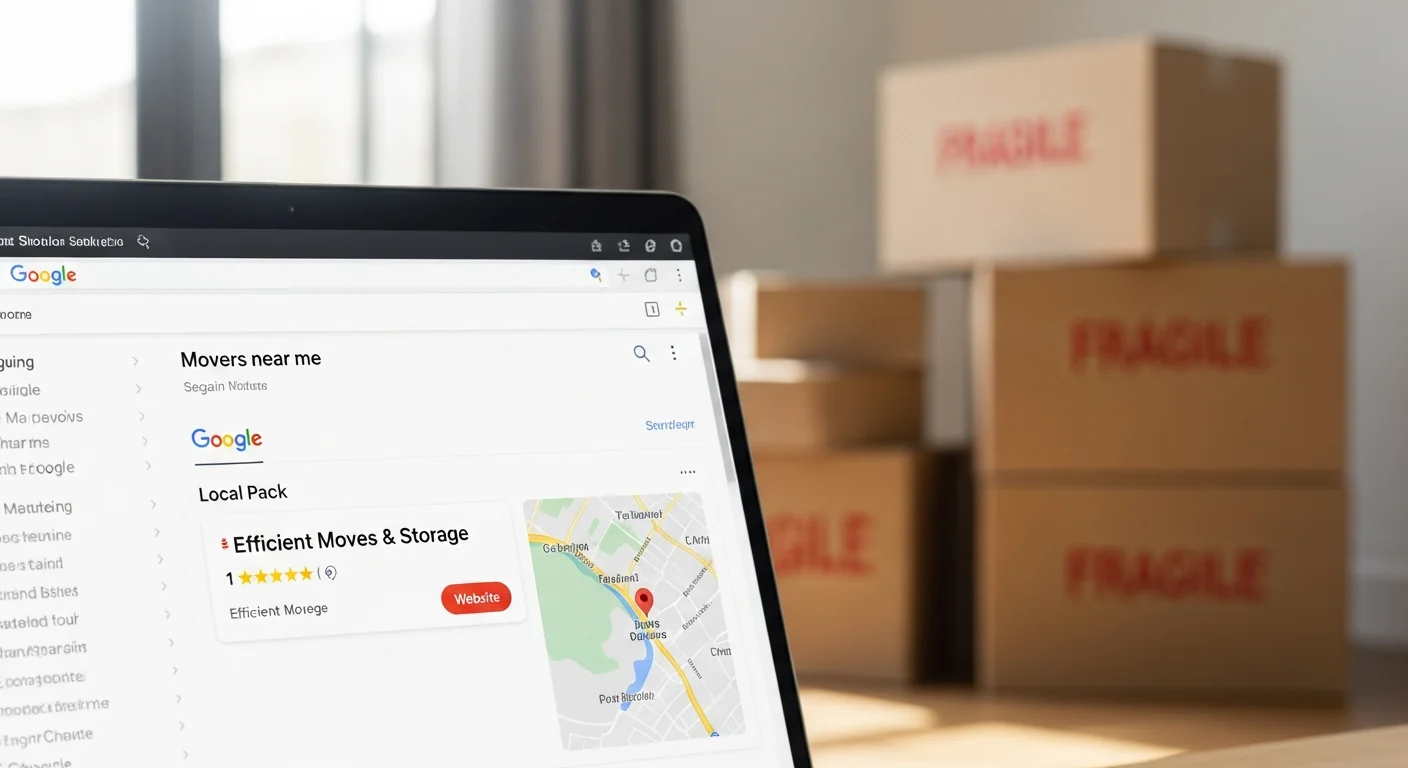
That last stat matters more than it looks. AI tools pull from the same review data and business-listing accuracy signals that feed traditional local search — the same profile completeness and review consistency that helps you rank in Google's local pack is now also feeding what ChatGPT or Gemini tells someone when they ask "who's a reliable mover near me." A complete, accurate, consistently-reviewed Google Business Profile isn't just a ranking factor anymore. It's becoming an AI-recommendation input too.
Practically, for a moving company that means: keep your Google Business Profile as the primary review destination (it's what most customers still check first and what feeds AI answers), but don't ignore Facebook, where a meaningful share of homeowners in the exact 30-55 demographic that hires movers are also reading recommendations, per DriveSales' own social-media-marketing research.
Do reviews actually help a moving company rank higher in local search?
Yes, and the 2026 data on ranking-factor weighting makes the connection explicit. Whitespark's 2026 Local Search Ranking Factors report — an annual survey of 47 local-search experts scoring 187 ranking factors — found that review signals and behavioral signals both increased in importance this year compared to the prior edition (Whitespark Local Search Ranking Factors 2026). Review count, review recency, and review velocity are explicitly tracked as a distinct signal group, separate from on-page content and backlinks, and that group's weight is rising, not falling.
There's a second-order effect worth calling out for the AI-search era specifically. Whitespark's own founder, Darren Shaw, notes that citations — consistent business information across the web — are "back" as a ranking factor specifically because AI search systems lean on them heavily, and 3 of the top 5 AI-search-visibility factors his 2026 survey identified are citation-related. Reviews are part of that same trust fabric: a moving company with 40 recent, consistent Google reviews and accurate contact information across the web is easier for both Google's local algorithm and an AI assistant to recommend with confidence than one with a thin, stale, or conflicting review history.
None of this means you can review your way to page one with a weak website or no service pages — Whitespark's data still ranks on-page and Google Business Profile signals above reviews for local pack visibility. But reviews are one of the few signals a small moving company can influence heavily just by running a disciplined process, without touching code or paying for links.
What should a moving company legally avoid when asking for reviews?
Two specific traps, both with real enforcement teeth behind them now. First, Google's own review policy explicitly prohibits soliciting reviews through incentives — discounts, gift cards, or "leave us a review and get $10 off" — or through review stations set up at your place of business (Google Business Profile Help). Violating reviews can be removed, and repeated abuse risks your whole profile.
Second, and more consequential: the FTC's Rule on the Use of Consumer Reviews and Testimonials took effect October 21, 2024, and it's not a guideline — it authorizes courts to impose civil penalties for knowing violations. The rule bans buying or selling fake reviews, bans compensating anyone in exchange for reviews expressing a particular sentiment, and it explicitly covers "advertising agencies, public relations firms, review brokers, or reputation management companies," not just the business itself (FTC Consumer Reviews and Testimonials Rule Q&A). If you outsource review generation to a marketing vendor, you're still on the hook if that vendor buys or fabricates reviews on your behalf.
The safe, and honestly more effective, path is a generalized ask sent to every customer who completed a job — no reward attached, no cherry-picking who gets the request. That's explicitly allowed under both Google's policy and the FTC rule, and it's also the version consumers say they respond to best: BrightLocal's 2026 data found 83% of consumers who were asked to leave a review went on to leave one, and 28% now say they'll "always" write a review when asked — up sharply from 16% the year before. Persistence works. A single ask that goes unanswered isn't a dead end, it's a signal to follow up once, not to give up on that customer's review entirely.
There's a related trap worth flagging even though it's less common in the moving industry than in influencer marketing: the FTC's separate Endorsement Guides require disclosure any time there's a financial or employment relationship between the person giving a recommendation and the business being recommended, and that applies to employee testimonials too (FTC's Endorsement Guides: What People Are Asking). If a crew lead posts a glowing "review" of the company they work for without disclosing that relationship, it's the same category of problem as an unpaid influencer post — the audience needs to know the connection to weigh the recommendation fairly.
How does the FMCSA fit into a moving company's trust story?
It's the credential most consumers never check but should, and it's a differentiator you can put directly in your review-request flow and your marketing. The Federal Motor Carrier Safety Administration runs a public complaint-history and mover-search database as part of its consumer-protection mission, and its own consumer guidance names "check the mover's complaint history in the FMCSA search tool database" as step three of five in choosing a reputable interstate mover (FMCSA, "Steps to Select a Mover"). The Better Business Bureau's "Know Your Mover" study on moving-fraud complaints backs this up from the consumer-harm side, documenting the price-gouging and hostage-load patterns that make consumers cautious about hiring movers sight-unseen in the first place (BBB "Know Your Mover" Study).
The practical takeaway: a clean FMCSA complaint history and a US DOT number displayed prominently are trust signals that work alongside your reviews, not instead of them. Mention them in your Google Business Profile description, your website, and even in review responses when relevant ("we're fully registered with the FMCSA, DOT #XXXXXX — happy to have you verify us before you book"). It's a low-effort way to answer the exact fear the BBB study documents, before a prospective customer has to go looking for it themselves.
What does a working reputation-management system actually look like day to day?
It's a pipeline, not a task. The moving companies winning the review game in 2026 are running something close to this sequence on every completed job:
- Job marked complete in your CRM or dispatch system. This is the trigger — not a calendar reminder, not a manual note. If scheduling and dispatch already tracks job completion, that event should kick off the next step automatically.
- Automated review request fires same-day. Given that 19% of consumers now expect same-day acknowledgment on the response side, the ask side should move at similar speed — request while the experience is still fresh, not three weeks later during a slow billing cycle.
- Follow-up nudge if no review lands within a few days. Not aggressive, not incentivized — just a second touch, since BrightLocal's own data shows persistence works: repeated asks measurably increase completion rates over a single one-shot request.
- Every incoming review gets a personalized response within 24-48 hours, referencing something specific to that job. Generic templates cost you the 50% of consumers who say boilerplate replies make them less likely to book.
- Negative reviews get triaged immediately — specific acknowledgment, a concrete fix, and an offer to resolve offline, following the response patterns BrightLocal's data shows consumers actually reward.
- Review velocity and sentiment get tracked over time, feeding back into training and operations — a cluster of complaints about the same issue (late arrivals, box damage, billing confusion) is an operations signal disguised as a review problem.
Doing steps 1-3 by memory across dozens of jobs a month is where most moving companies fall down — not because the team doesn't care, but because a manual process competes with the actual job of moving people's houses. reputation management for moving companies automates the request sequence (email + SMS, timed at 2 hours, 24 hours, and 72 hours after job completion) and aggregates incoming reviews from Google, Yelp, and Facebook into one dashboard with AI-suggested response drafts, so step 4 doesn't require someone hunting across three logins every morning.
There's also a retention angle worth connecting here. A repeat customer or a referral from a satisfied one is worth more over time than a single one-off job — the customer lifetime value math tilts heavily toward companies that keep past customers happy enough to hire them again or send friends their way, and a visible, well-managed review profile is one of the cheapest ways to nudge that number up. On the flip side, a pattern of unresolved complaints in your reviews is often the earliest visible signal of a churn rate problem before it shows up in your books. For the broader industry numbers behind all of this — moving volume, average job value, competitive density — see DriveSales' moving industry statistics resource, which we keep current with primary government and industry data.
If you're trying to size the payoff before committing to a system change, DriveSales' ROI calculator can model what a few extra booked jobs a month from a stronger review profile is actually worth against your current close rate.
What's the fastest way to see this system pay off?
Stop treating review generation as a marketing afterthought and start treating it as a dispatch-triggered workflow, the same way you already treat invoicing or customer-portal notifications. The 2026 data is consistent on one point: consumers aren't reading fewer reviews, they're reading them more carefully, expecting them fresher, and expecting a real human response faster than ever. A moving company that builds the automated request-and-response loop now is building a compounding asset — every job adds proof, and every fast, specific response adds trust — while competitors still relying on "we'll ask happy customers when we remember" fall further behind on both review count and review recency.
If you want to see what that request-and-response sequence looks like running against your own job schedule, book a DriveSales demo and we'll walk through it against your actual completed-job volume — how many requests would have gone out last month, and what your review count would look like with the loop automated instead of manual. Pair it with a look at DriveSales pricing to see where reputation management sits relative to the rest of the platform, including CRM systems moving companies actually use to track jobs day to day.
Frequently Asked Questions
How many Google reviews does a moving company need to look credible?
Aim for a rolling total of at least 20, since BrightLocal's 2026 data shows 47% of consumers won't consider a business with fewer than 20 reviews. But volume alone isn't enough — 74% of consumers only weight reviews from the last three months, so the real target is a steady stream of new reviews every month, not a one-time push to 20 and then silence.
Is it illegal to offer a discount for a Google review?
Yes, per Google's own review policy, which prohibits soliciting reviews through incentives or in-store review stations, and it risks running afoul of the FTC's 2024 Consumer Reviews and Testimonials Rule if the incentive is conditioned on writing a positive review. The safe approach is a generalized request sent to every customer with no reward attached.
How fast should a moving company respond to a negative review?
As fast as possible, ideally same-day. BrightLocal's 2026 survey found 19% of consumers now expect a same-day response (up from 6% the year before) and 81% expect a reply within a week. Acknowledge the specific issue, state a concrete fix, and move the resolution to a phone call rather than a public back-and-forth.
Does responding to every review actually change whether people book?
Yes — 80% of consumers in BrightLocal's 2026 survey said they're more likely to use a business that responds to all of its reviews, compared to just 45-47% for businesses that only reply to positive or only to negative feedback, and 42% said they're unlikely to use a business that never responds at all.
Which review platform matters most for a moving company: Google, Facebook, or something else?
Google remains the largest single source (71% of consumers use it for reviews per BrightLocal's 2026 data, though down from 83% the year before), but Facebook and Apple Maps are both growing, and 45% of consumers now use AI tools like ChatGPT for local recommendations, up from 6% a year earlier. A profile that's complete and consistent across all of them performs best.
Can a third-party marketing agency get in trouble for fake reviews on my behalf?
Yes. The FTC's 2024 rule explicitly states that advertising agencies, PR firms, review brokers, and reputation management companies can be held liable if they write, create, or sell fake reviews, or if they pay for reviews conditioned on sentiment — the liability isn't limited to the business itself.
Does having a clean FMCSA record actually help with reviews or bookings?
Indirectly, yes. FMCSA's own consumer guidance tells prospective movers to check a company's complaint history before booking, and the BBB's "Know Your Mover" study documents why: moving fraud complaints are common enough that consumers actively look for verification. Displaying your US DOT number and a clean record alongside your reviews answers that concern before it becomes an objection.