The US moving services industry is worth $23.4 billion in 2025, according to IBISWorld. That's a massive market. But with roughly 7,667 businesses competing for customers, the movers who win aren't the ones with the biggest trucks. They're the ones with the sharpest marketing.
This guide breaks down exactly how to build a marketing plan that generates consistent leads for your moving company, backed by real data and proven channels.
Key Takeaways
- Most moving research and booking activity now starts online, and a majority of those searches happen on mobile
- 76% of people who search on their smartphones for something nearby visit a business within a day (Think with Google)
- Calling a web lead within 5 minutes instead of 30 makes it 100x more likely you make contact, and 21x more likely the lead qualifies (MIT Sloan/InsideSales.com Lead Response Management Study, Oldroyd 2007)
- Home & Home Improvement, the closest available industry benchmark to moving services, averages $8.33 per click and $90.92 per lead in Google Ads (WordStream/LocaliQ 2026 Google Ads Benchmarks)
Why Does Your Moving Company Need a Marketing Plan?
About 25.87 million Americans relocated in 2024, roughly 8% of the population, which was actually a record low (U.S. Census Bureau, 2025). Fewer people are moving, but those who do move are searching online first. Moving research and booking activity has shifted decisively online, and most of that activity now starts on a mobile device.
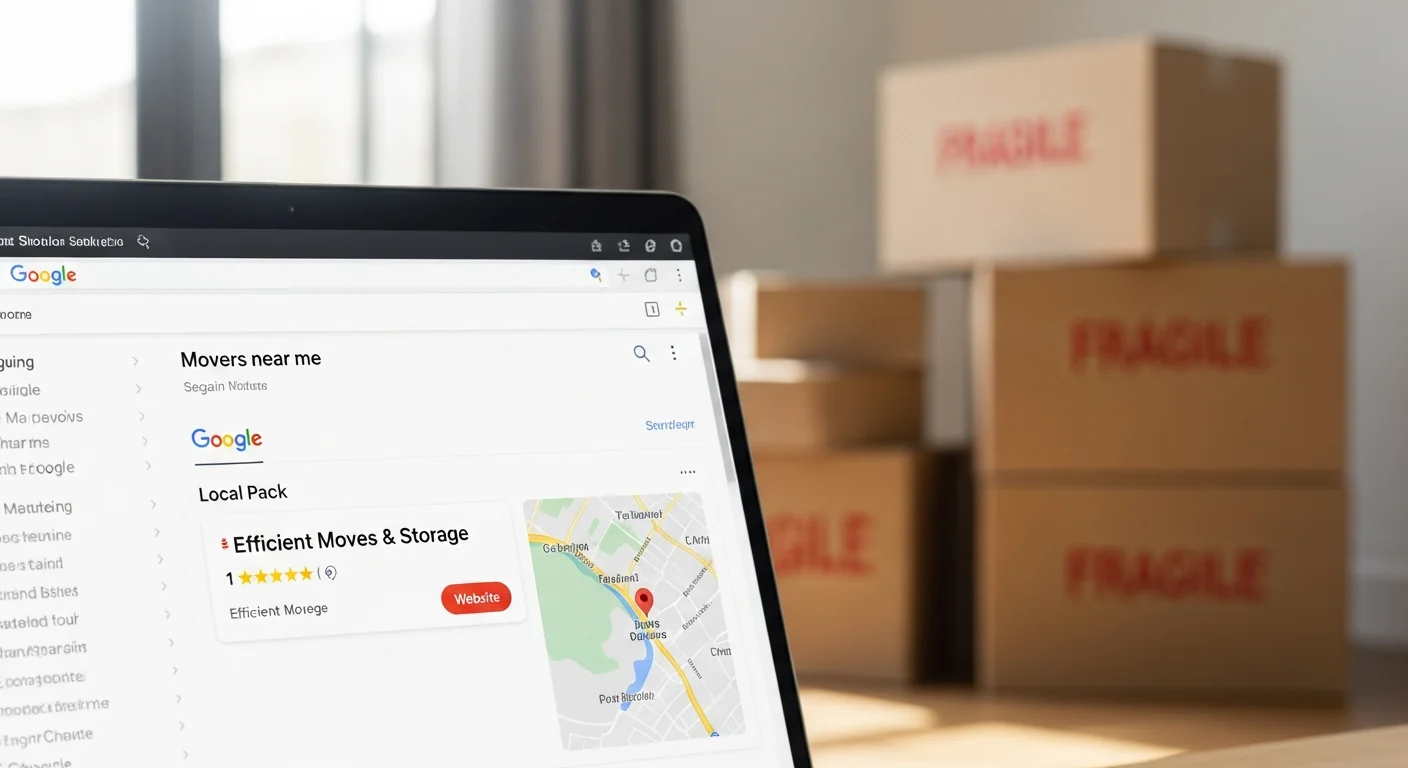
What does this mean for you? If your moving company doesn't show up when someone Googles "movers near me," you're invisible to three-quarters of your potential customers. A marketing plan isn't a nice-to-have. It's how you stay in business when the pool of movers is shrinking and the competition for each lead is growing.
The good news: most moving companies still rely on word-of-mouth and yard signs. That gives you a real edge if you're willing to invest in digital marketing. Let's look at where to start.
Who Are You Actually Marketing To?
Before spending a dollar on ads, get clear on your customer segments. Moving companies typically serve three distinct groups, and each one responds to different messaging:
- Residential movers make up the bulk of the market. These are families relocating for work, retirees downsizing, or young professionals moving apartments. They're price-sensitive, they read reviews obsessively, and they want reassurance that their stuff won't get damaged.
- Commercial clients are businesses relocating offices or expanding to new locations. They care more about minimizing downtime than saving a few hundred dollars. Longer sales cycles, but higher ticket sizes.
- Specialty moves cover pianos, antiques, art, and other high-value items. These customers will pay premium rates for expertise and insurance. They're searching for specialists, not generalists.
Here's the practical takeaway: don't run the same Facebook ad for all three. A family moving across town needs to hear "licensed, insured, 5-star reviews." A business relocating an office needs to hear "weekend moves, zero downtime, project manager included."
What Makes Local SEO the Highest-ROI Channel for Movers?
According to Google's own mobile search research, 76% of people who search on their smartphones for something nearby visit a business within a day (Think with Google). Even more compelling, 28% of those local searches end in a purchase. For moving companies, that's an incredible conversion rate compared to almost any other marketing channel.
Your Google Business Profile is the foundation here. Birdeye's 2025 State of GBP report found that fully optimized profiles appear 80% more often in search results and generate 4x more website visits than incomplete ones (Birdeye, 2025). The average GBP listing receives about 81 monthly actions, including calls, direction requests, and website clicks.
How to Optimize Your Google Business Profile
- Fill out every single field. Hours, services, service area, attributes, business description. Leave nothing blank.
- Upload 10+ high-quality photos of your trucks, crew, and completed moves. Profiles with photos get 42% more direction requests.
- Post weekly updates. Google rewards active profiles with better visibility.
- Respond to every review within 24 hours, good or bad.
- Add your services with descriptions and pricing ranges where applicable.
Building Local Citations
Beyond Google, list your company on Yelp, Angi, HomeAdvisor, the Better Business Bureau, and industry-specific directories like MovingCompanyReviews.com. Keep your business name, address, and phone number identical everywhere. Even small inconsistencies (like "St." vs "Street") can hurt your local rankings.
How Do Online Reviews Drive (or Kill) Your Bookings?
Reading reviews before choosing a business is close to universal behavior now: Pew Research found that two-thirds of frequent online shoppers say they nearly always read reviews before buying (Pew Research Center), and that share has only grown as review reading has become a default step in local buying decisions. A moving company sitting at a mediocre star rating is competing for the minority of customers willing to book without checking reviews first.
Think about what that means for a moving company sitting at 3.5 stars. You're losing the large majority of customers who check reviews first and skip straight to a better-rated competitor. Meanwhile, Capital One Shopping Research found that displaying 5 or more customer reviews can boost conversions by up to 270% (Capital One Shopping, 2026).
A Practical Review Strategy
- Ask at the right moment. Send a review request via text message the evening after a successful move, when the relief and gratitude are still fresh. Don't wait a week.
- Make it frictionless. Send a direct link to your Google review page. Every extra click you add drops your response rate.
- Respond to negative reviews professionally. A thoughtful response to a 1-star review actually builds more trust than 10 generic 5-star ratings. Future customers are watching how you handle problems.
- Showcase reviews on your website. Don't just hope people find your Google listing. Pull your best reviews onto your homepage and pricing page.
Which Paid Advertising Channels Work Best for Movers?
There's no moving-industry-specific published benchmark for Google Ads costs, so the closest verified proxy is the Home & Home Improvement category, which averages $8.33 per click and $90.92 per lead (WordStream/LocaliQ 2026 Google Ads Benchmarks). That might sound expensive, but consider context. If your average move is worth $1,500 and you close 20% of leads, each $91 lead is still generating $300 in revenue on average. That's more than a 3x return.
WordStream's 2025 benchmarks show home services Google Ads converting at 7.33% on average (WordStream, 2025). Facebook Ads tend to be cheaper per click, with home improvement CPCs around $0.99, but the conversion rate for lead campaigns sits at about 5.22% (WordStream, 2025).
Google Ads vs. Facebook Ads for Movers
See our full breakdown of Google Ads for moving companies for the complete account setup, negative-keyword list, and Local Services Ads comparison. Google Ads capture people who are actively searching for a mover right now. This is high-intent traffic. When someone types "moving company near me," they need to move. Your job is to show up and make a compelling offer.
Facebook Ads are better for building awareness and retargeting. Someone who visited your website but didn't request a quote? A Facebook retargeting ad can bring them back. Facebook is also effective for promoting seasonal deals or reaching people in neighborhoods with high turnover.
The best approach? Use both. Run Google Ads for bottom-of-funnel captures and Facebook for awareness and retargeting. Track your cost per acquisition on each channel and shift budget toward whatever's working.
Does Content Marketing Actually Generate Moving Leads?
Content marketing generates 3x more leads than traditional outbound marketing and costs 62% less (DemandSage, 2025). For moving companies, this typically means blogging, local guides, and educational resources.
What kind of content works? Think about what your customers are Googling before they hire a mover:
- "How much does it cost to move a 3-bedroom house?"
- "Moving checklist: what to do 30 days before moving day"
- "How to pack fragile items for a long-distance move"
- "Best neighborhoods in [your city] for families"
Each of those queries is a potential blog post that attracts people who are actively planning a move. They land on your site, find genuinely helpful advice, and then see your "Get a Free Quote" button. That's content marketing in action.
Don't Forget Email
Email marketing returns $36 for every $1 spent, a 3,600% ROI according to DemandSage's 2025 data (DemandSage, 2025). Average open rates hit 43.46% in 2025 (MailerLite, 2025).
Build an email list from your quote requests (even the ones that don't convert). Send a monthly newsletter with moving tips, seasonal promotions, and company updates. It keeps you top-of-mind for when they're finally ready to book.
Why Is Speed to Lead Your Secret Weapon?
This might be the single most important number in this entire article: a lead you call within 5 minutes is 100x more likely to actually pick up than one you call after 30 minutes, and 21x more likely to qualify once you reach them (MIT Sloan/InsideSales.com Lead Response Management Study, Oldroyd 2007 — three years of data across six companies and over 100,000 call attempts). The odds of making contact drop by more than 10x in just the first hour of delay.
Even more striking, 78% of customers buy from the first company that responds (LeadOwl, 2025). And yet, 63% of businesses don't respond to leads at all, with an average response time north of 29 hours.
Do you see the opportunity? Most of your competitors are leaving money on the table by responding slowly, or not at all. If you can respond to every lead within 5 minutes, you'll win business that has nothing to do with your pricing or your truck fleet.
How to Hit 5-Minute Response Times
- Use a CRM with auto-notifications. The moment a lead comes in, your phone should buzz.
- Set up automated text responses. Even a simple "Thanks for reaching out! We'll call you in the next few minutes" buys you time while confirming the lead is real.
- Assign leads in real-time. Don't let them sit in a shared inbox. Route them to specific salespeople based on availability.
- Track response times religiously. What gets measured gets managed. If your average response time creeps above 10 minutes, figure out why.
How Do You Measure What's Working?
You can't improve what you don't measure. Track these metrics monthly:
- Cost per lead (CPL) by channel. Know exactly how much you're paying for each Google Ads lead vs. each organic lead vs. each referral.
- Lead-to-booking conversion rate. If you're getting plenty of leads but not enough bookings, the problem is your sales process, not your marketing.
- Average revenue per move. Are your marketing efforts attracting the right customers, or are you spending $53 per lead to book $500 local moves?
- Customer acquisition cost (CAC). Total marketing spend divided by total new customers. This is your north star.
- Return on ad spend (ROAS). For every dollar in ads, how much revenue comes back?
Set up Google Analytics on your website, use UTM parameters on all your ad campaigns, and review performance weekly. Monthly is too slow to catch problems. Weekly lets you kill underperforming ads before they drain your budget.
Frequently Asked Questions
How much should a moving company spend on marketing?
Most successful moving companies invest 7-10% of their gross revenue in marketing. For a company doing $500,000 in annual revenue, that's $35,000 to $50,000 per year. Start with Google Ads and local SEO, then expand to other channels as you learn what converts.
What's the fastest way to get more moving leads?
Google Ads delivers the fastest results because you're targeting people who need a mover right now. You can start generating leads within 24-48 hours of launching a campaign. Pair it with an optimized Google Business Profile for maximum visibility.
Is social media worth it for moving companies?
Yes, but primarily for brand building and retargeting, not direct lead generation. Facebook and Instagram work well for showcasing your team, sharing customer stories, and running retargeting ads to people who've visited your site. For a deeper dive, read our complete guide to social media marketing for movers.
How many Google reviews do I need to rank well?
There's no magic number, but a steady stream of recent, genuine reviews matters more than hitting any specific count. Aim for 2-4 new reviews per week rather than a one-time batch request — review recency signals an active, trustworthy business just as much as total review volume does.
Should I hire a marketing agency or do it in-house?
It depends on your budget and bandwidth. If you're running a 2-5 truck operation, you probably don't have time to manage Google Ads, SEO, and social media yourself. A specialized home services marketing agency can often deliver better results for $2,000-4,000/month than a DIY approach. Once you scale past 10 trucks, consider bringing marketing in-house for more control.