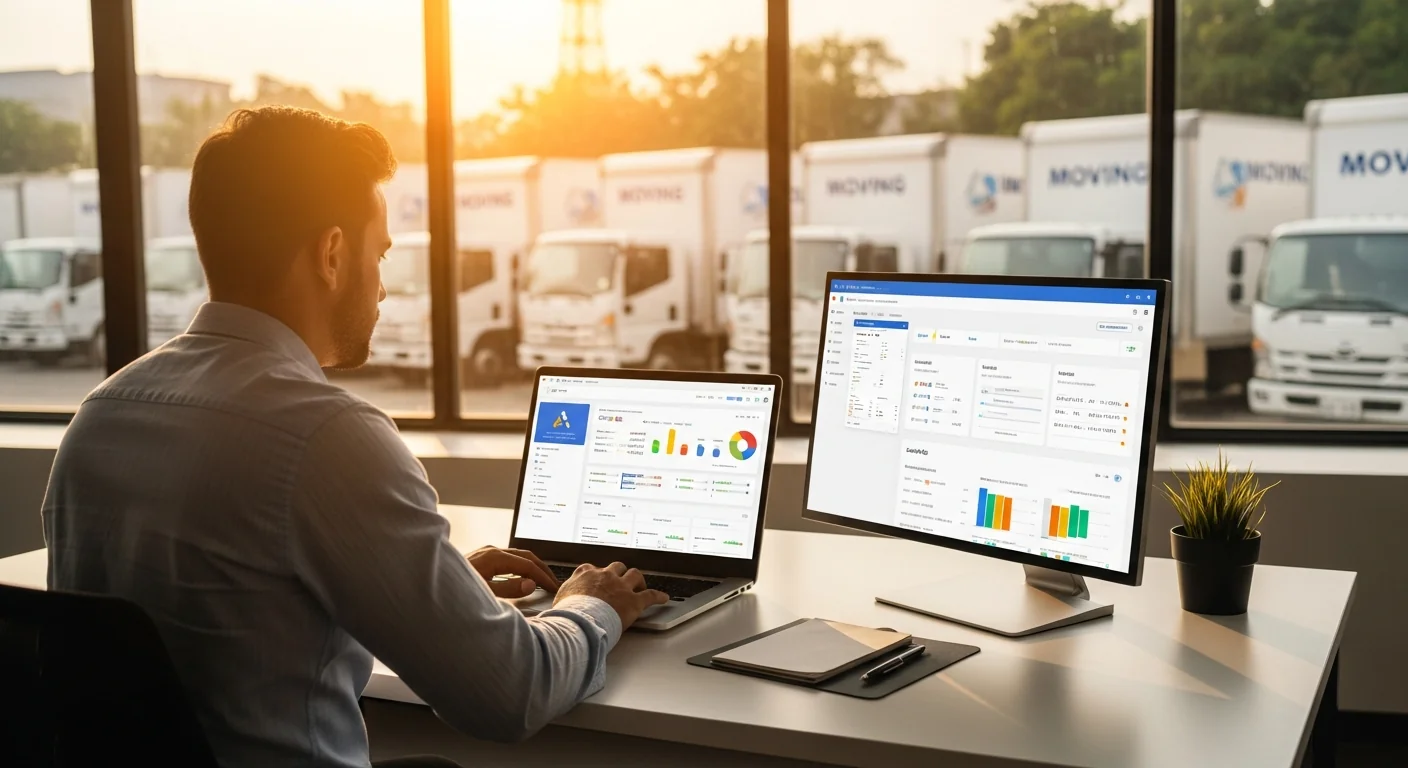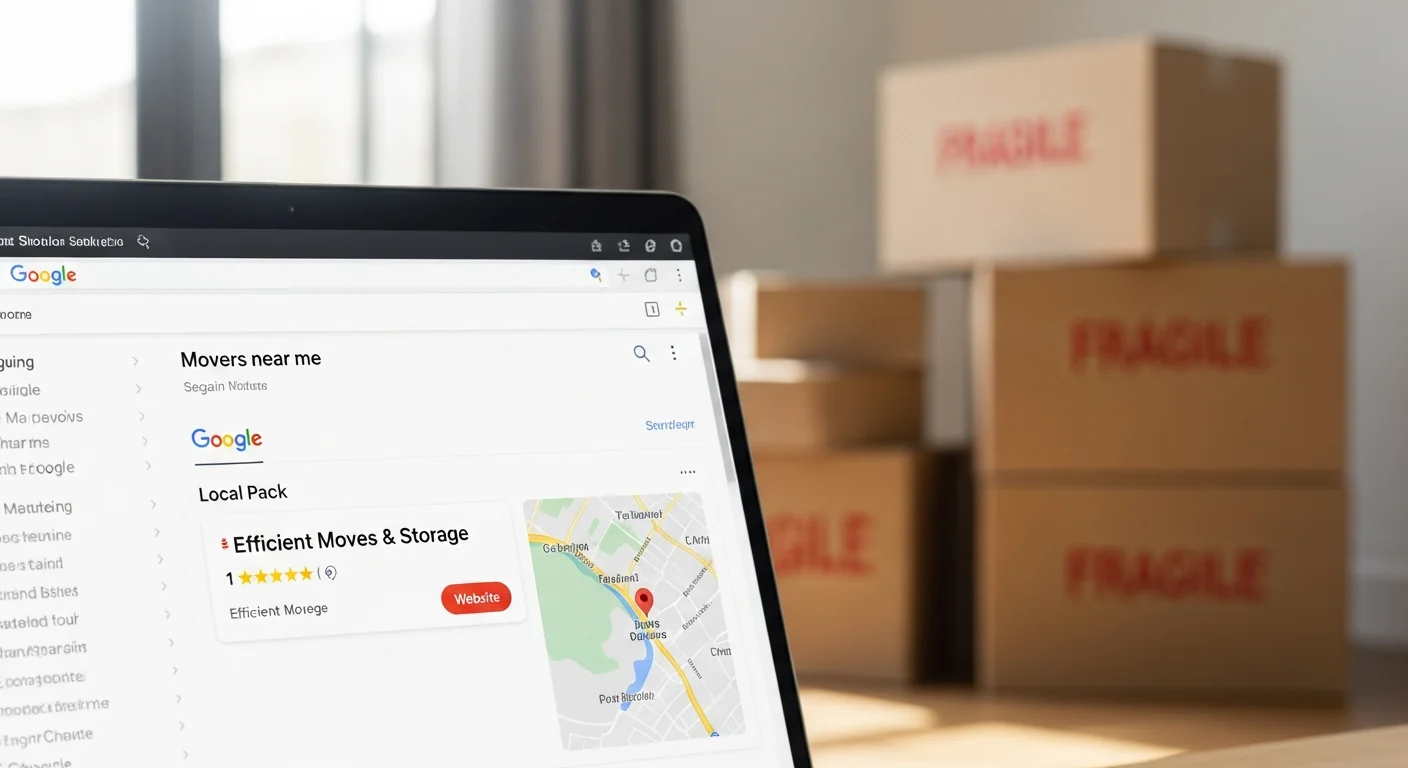
Most moving company websites lose the job before the phone ever rings. A homeowner lands on your site from a Google search, waits nine seconds for the hero image to load, can't find a phone number without scrolling twice, and clicks back to try your competitor instead. That's not a design problem. That's a revenue problem — booked jobs walking out the door because of how a page is built, not because your crew or your pricing is worse.
This guide breaks down exactly what converts on a moving company website: the elements that turn a visitor into a booked estimate, the ones that quietly kill conversions, and how to fix the gap between "we have a website" and "our website sells."
Why does a moving company's website matter more than its ads?
A website is where every marketing dollar you spend actually converts or doesn't. Ads, SEO, referrals, and Google Business Profile clicks all funnel through it — if the page is slow or confusing, you're paying to send customers to a dead end. Digital Applied's 2026 page speed data shows the average mobile page still takes 8.6 seconds to load, while 53% of mobile visitors abandon a page that takes longer than three seconds, and every additional second of load time costs roughly 7% of conversions (Digital Applied, "Page Speed Statistics 2026"). Google's own Core Web Vitals standard sets the bar precisely: a page should show its main content within 2.5 seconds and respond to a tap or click within 200 milliseconds to count as a good experience (web.dev, "Web Vitals") — most moving-company sites, hosted on templated builders with heavy imagery, miss both marks by a wide margin. For a moving company running paid search at $10–$20+ CPC on branded and local-intent keywords, a slow site isn't cosmetic — it's paying full price for traffic and throwing most of it away.
Local search behavior makes the stakes clearer. 76% of people who perform a "near me" search visit a business within 24 hours, and 98% of consumers now research a local business online before contacting it (BizIQ, "Local Search Statistics 2026", sourced from Google/Think with Google and BrightLocal). A moving company's website is frequently the *only* touchpoint a homeowner has before deciding who to call for a quote — there's no storefront to walk past, no showroom to browse. The page has to do the entire trust-building job in under a minute, and a documented conversion rate benchmark exists for exactly this reason: it's the number that tells you whether the page is doing that job.
What makes a homeowner trust a moving company enough to request a quote?
Trust signals, displayed close to the point of decision, not buried in an "About Us" page. Reviews are the single biggest lever: 97% of consumers read reviews of a local business before visiting it, and displaying reviews on-page increases conversion rates by an average of 76.7% — climbing past 143% once a business shows more than 100 reviews (Capital One Shopping, "Online Review Statistics 2026"). Reviews from verified customers convert 15% better than anonymous ones, so pulling live Google reviews onto the homepage and estimate page — not just linking out to a profile — earns more trust than a static five-star badge.
Beyond reviews, the trust stack that actually moves the needle for a moving company:
- Real photos of your own crew and trucks, not stock photography. Homeowners are inviting strangers to carry their belongings — generic stock imagery signals "template site," which undercuts trust before a single word is read.
- Licensing and insurance proof visible above the fold. MC number, USDOT number, and insurance coverage aren't just compliance details — they're conversion copy for a customer who has heard moving-scam horror stories. (See our guide on moving company insurance costs for what should actually be covered before it goes on the page.)
- A visible, real phone number in the header on every page, not just the contact page. Movers researching multiple companies in the same session will call the first one they can reach easily.
- Before/after or in-progress photos of actual jobs — a loaded truck, a labeled inventory sheet, a packed kitchen. This does for moving companies what product photography does for e-commerce: it removes the guesswork about what the service actually looks like.
How fast does an instant quote form need to load and how short should it be?
Fast enough that it doesn't compete with the visitor's patience, and short enough to complete in under a minute. VWO's 2026 conversion benchmark data puts the average professional-services conversion rate at 4.6% — moving falls into this bucket, since it's a considered, trust-dependent local service rather than an impulse e-commerce purchase ([VWO, "43 Conversion Rate Optimization Statistics [2026]"](https://vwo.com/conversion-rate-optimization/conversion-rate-optimization-statistics/)). The same research documents a UK insurance company raising form submissions 31% simply by redesigning its quote form to ask fewer questions up front, and a travel company lifting bookings 33% by adding a single, clearer call-to-action button. On the specific question of form length, HubSpot's 2023 survey of 101 marketing and advertising professionals found 30.7% consider four fields the ideal number on a landing page form, and a separate e-commerce study it cites found three fields converts best of all — the pattern across both is fewer, not more (HubSpot, "16 Landing Page Statistics For Businesses").
For a moving company, that translates to a specific form structure:
- Move type and rough size first (studio, 2-bed, office) — the easiest questions, get the visitor committed before asking anything harder.
- Origin and destination ZIP codes, not full addresses — full address fields feel invasive on a first form and can be collected later.
- Preferred move date and a phone number, then submit. Everything else — inventory detail, stairs, specialty items — belongs in a follow-up call or a second-stage form, not the first ask.
A long, 12-field intake form asking for a full inventory before a homeowner has even decided you're a legitimate option is a conversion killer. Split it: a fast first form to capture the lead, a detailed intake after the first phone call or automated follow-up has already built some trust — DriveSales' instant online estimates tool is built around exactly this two-stage structure.
Does live chat actually generate more moving leads, or is it just overhead?
For a considered local service like moving, live chat converts because it answers the one question every visitor has and no page can fully anticipate: *does this apply to my specific situation?* VWO's 2026 conversion data documents live chat lifting revenue per chat hour by 48% and conversion rates by 40% in comparable service-based categories ([VWO, "43 Conversion Rate Optimization Statistics [2026]"](https://vwo.com/conversion-rate-optimization/conversion-rate-optimization-statistics/)). The overhead concern is real if chat means a person has to sit and monitor it — the fix is treating chat as a landing page lead-capture and routing tool, not a full-time support desk: a widget that answers FAQs automatically and routes anything specific straight into the same pipeline as a phone call or form submission, so nothing requires a human online 24/7 to still capture the lead.
What should the homepage above-the-fold section actually contain?
Everything a homeowner needs to decide "yes, keep reading" in the first five seconds:
- A clear, specific headline — "Licensed Local & Long-Distance Movers in [City]" outperforms a vague tagline like "Your Trusted Moving Partner," because it answers the "is this what I need" question instantly.
- One primary call-to-action — "Get Your Free Quote" — repeated consistently in the same visual style across the entire site, not three different competing buttons.
- A visible star rating and review count, pulled live from Google, not a static image that could be outdated.
- The phone number, always, in the header.
Resist the temptation to cram service area maps, testimonials, and a video hero into the first screen. HubSpot's research shows relevant video content on a landing page can lift conversions by as much as 86% — but that only holds if the page still loads fast and the video doesn't compete with the primary CTA for attention (HubSpot, "16 Landing Page Statistics For Businesses"). A background video hero that adds three seconds to load time trades one conversion lever for a bigger loss on another.
How many pages does a moving company website actually need?
Fewer than most owners think, but each one needs a specific job:
| Page | Job it does |
|---|---|
| Homepage | First-impression trust + primary CTA |
| Service area pages (one per city/region served) | Local search visibility — "movers in [city]" |
| Service type pages (local, long-distance, commercial, storage) | Match search intent to the right offer |
| Instant quote / estimate page | Convert the visitor into a lead |
| Reviews / testimonials page | Deepen trust for visitors still deciding |
| About / licensing page | Compliance trust signals, team photos |
A single generic "Services" page trying to rank for every city and every move type competes against itself in search results. Dedicated city pages — even short ones, 300–500 words with local specifics — consistently outperform one page trying to be everything, because they match the exact phrasing homeowners search for local moves. This is the same principle behind a solid marketing plan: match the page to the search intent, not the other way around.
What's the DriveSales angle — should the website do the selling or the software?
The website's only job is to convert a stranger into a lead. What happens after that lead submits a form is where most moving companies actually lose the job — not because the website failed, but because nobody called back fast enough. A beautifully converting website that funnels leads into a shared inbox or a sticky note pad is still losing bookings; a plain website that funnels every lead into an automated, five-minute response sequence will out-book it. DriveSales' moving-leads feature captures every form submission, call, and chat handoff from your website into a single pipeline and auto-responds within two minutes — the site converts the click, DriveSales converts the lead into a booked job.
Pair a fast, trust-forward website with instant online estimates instead of a static quote form, and the two systems compound: better on-page conversion feeding a CRM that never lets a lead go cold. Curious what a faster response-and-booking pipeline is actually worth? Run the numbers on the ROI calculator, or check DriveSales pricing to see what plan fits a website redesign budget alongside it. For the broader industry numbers behind a lot of the local-search and mobile behavior cited above, see our moving industry statistics hub.
FAQ
How much should a moving company spend on website design?
There's no fixed moving-industry benchmark, but the U.S. Small Business Administration frames marketing spend as a percentage-of-revenue decision that should track ROI rather than a flat number (SBA, "How to Get the Most From Your Marketing Budget"). A one-time website build is a capital investment, not a recurring marketing line item — prioritize page speed and a working quote form over visual polish if budget is limited; conversion mechanics move revenue more than aesthetics do.
Should a moving company's website have live chat?
Yes, if it's routed into the same lead pipeline as phone and form submissions rather than run as a separate, unmonitored channel. Automated chat that answers common questions (service area, pricing range, availability) and escalates anything specific captures leads around the clock without requiring a person online at all hours.
How many reviews does a moving company need on its website before it helps conversions?
Enough to look active and recent — conversion lift from displaying reviews jumps most dramatically once a business passes roughly 100 total reviews, per Capital One Shopping's 2026 review-statistics compilation. A newer company with 15–20 recent, detailed reviews still benefits meaningfully; the bigger risk is a stale review widget that hasn't updated in a year.
Is a mobile-first design actually necessary for a moving company's site?
Yes — a large share of local search traffic arrives on mobile, and mobile pages that load slowly lose the majority of that traffic before it ever reaches a quote form, per Digital Applied's 2026 page speed data. If a homeowner searching "movers near me" on their phone hits a slow, non-mobile-optimized page, they'll tap back and call the next result instead.
Does a moving company need a blog on its website?
Not as a website-design priority — a blog supports long-tail SEO over time, but it won't fix a page that loads slowly or a form that's too long. Fix conversion mechanics (speed, form length, trust signals) before investing in content volume; a fast, trustworthy five-page site converts better than a slow fifty-page one.
What's the single highest-impact fix for an underperforming moving company website?
For most companies it's page speed combined with form length — the two factors with the most directly measured conversion impact in the data above. A homeowner who reaches a fast-loading page with a short, three-field first form is far more likely to convert than one who waits nine seconds and then faces a twelve-question intake form.