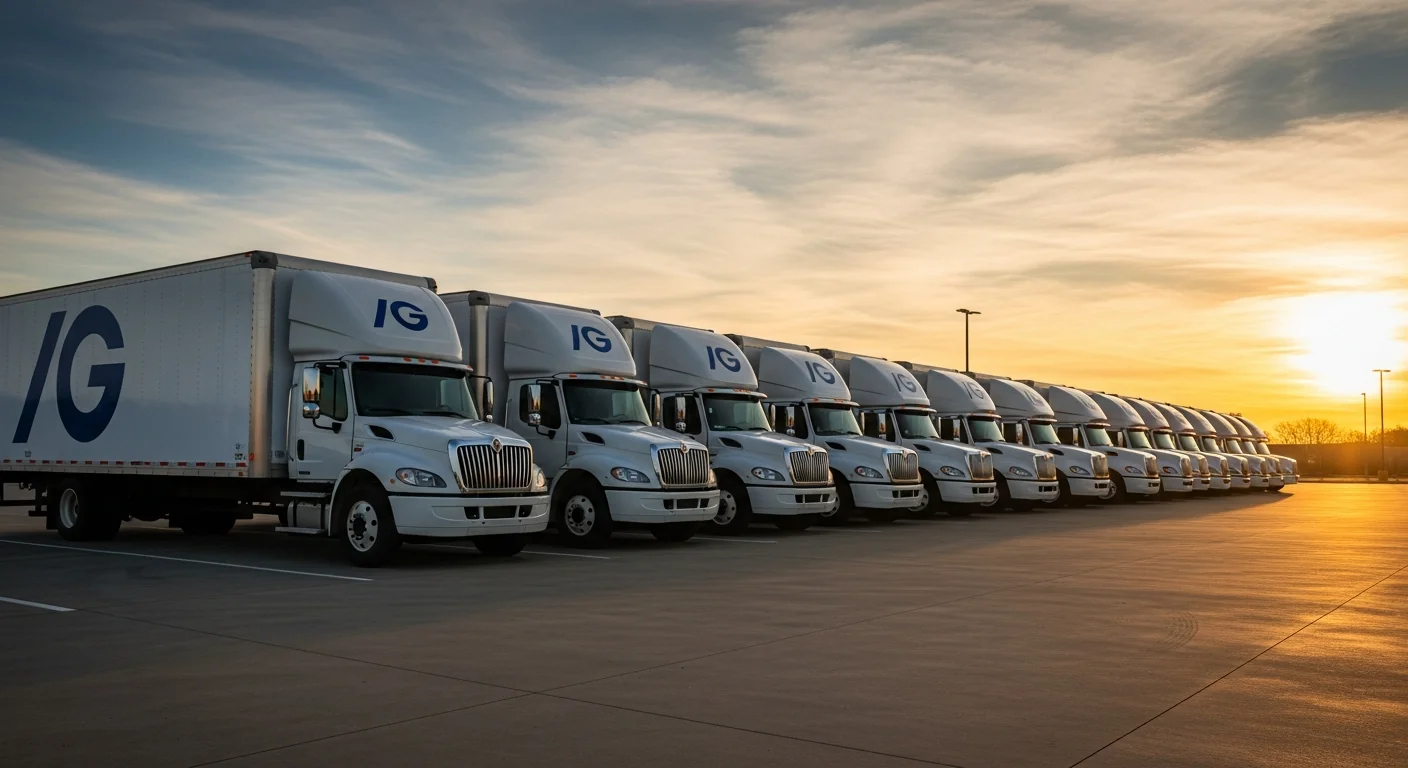
Most moving companies never get past 5 trucks. The jump from a founder-operator hustling every job personally to a business that runs without you in every truck requires a different set of systems at each stage, and the companies that stall out almost always tried to skip one. Here's the real roadmap from 2 trucks to 20, phase by phase, with the specific breakpoints where owners get stuck.
What Has to Be True Before You Add Truck Number 3?
At 2-5 trucks, you're still the business. Every job likely has your fingerprints on it somewhere, whether that's the sales call, the day-of dispatch, or driving the truck yourself. Before adding capacity, three things need to already be working:
Lead flow has to be predictable, not lucky. If your bookings depend on this month's referrals showing up, adding a truck just gives you more idle payroll on slow weeks. Build at least two repeatable lead channels (see our breakdown of proven lead sources for moving companies) before you add headcount to serve demand that might not show up.
Your pricing has to survive scrutiny. A gut-feel quote that "usually works out" doesn't scale past the point where you're personally checking every job's numbers. Know your real cost per lead and what a job actually costs you to run, labor, fuel, insurance, before you're relying on a crew lead to price jobs the same way you would.
Someone besides you has to be able to run a job start to finish. If every escalation call still comes to your cell phone, you don't have a business with 2 trucks, you have one truck and a spare. Cross-train at least one lead mover who can handle a walkthrough, a dispute, and a tip conversation without calling you.
How Do You Build Systems Without Killing Speed? (5-10 Trucks)
This is where most moving companies actually stall, not at the top end, but right here. You have too many trucks to run from memory and too few to justify a full management layer, so the temptation is to keep improvising a little longer.
Don't. This is the phase where a CRM built for moving companies stops being optional. At 2 trucks, a whiteboard and a group text work. At 7 trucks, that same whiteboard means double-bookings, lost estimates, and a dispatcher who's the only person who knows what's actually scheduled tomorrow. The dispatch and scheduling system needs to hold the truth about your day, not one person's memory of it.
Three systems earn their keep specifically in this range:
- Documented processes, not tribal knowledge. Write down your estimate walkthrough script, your damage-claim process, your new-hire first week. If it only exists in your head or your best crew lead's head, it doesn't survive either of you taking a week off.
- A real training path. New hires at 5-10 trucks are learning from whoever's free that day, which means quality swings with who trained them. A short, consistent onboarding sequence, even one week's worth, pays for itself the first time it prevents a damage claim.
- Middle management capacity. Somewhere in this range you need your first person whose job is running operations, not moving boxes, freeing you to work on the business instead of in it.
What Breaks When You Push Past 10 Trucks?
At 10+ trucks, the problems that were annoying at 7 trucks become expensive at 12. A whiteboard dispatch system that cost you one missed pickup a month at 6 trucks costs you three a week at 12, because there are more trucks, more crews, and more moving pieces for one dispatcher to track by hand.
This is where dispatch software built for moving companies, not adapted from generic field service tools, earns a hard look. Generic scheduling software wasn't built around cubic-foot estimates, crew-size-to-truck-size matching, or the way a moving job's timeline can blow up mid-route when a walkup building has no elevator. A dispatch board that actually understands the moving workflow prevents the kind of double-booking that a growing fleet makes statistically inevitable on a manual system.
You'll also need:
- A dedicated management layer, not just a lead crew member wearing two hats. At this scale, someone needs to own scheduling, someone needs to own crew performance, and those can't both be the same overworked person.
- Multiple crews running in parallel with real accountability, tracked by job outcome, not gut feel about who's "good."
- Marketing that can absorb a bigger, steadier lead volume, since a fleet this size needs a fuller pipeline than word of mouth and a Google Business Profile can reliably deliver.
Where Does the Money Actually Come From to Add Trucks?
Growth needs capital, and moving companies typically finance fleet expansion through one of a few channels. The SBA's 7(a) loan program, the government's primary small-business loan guarantee program, backs loans up to $5 million for equipment purchases including trucks, with the lender setting the actual rate and term based on your creditworthiness and the loan amount. A 7(a) Working Capital Pilot line, a newer variant of the same program, caps interest at the base rate plus 3.0% to 6.5% depending on loan size, and runs up to 60 months. These aren't the only path (equipment financing and traditional bank loans are common alternatives), but they're the one channel every mover should at least check eligibility for before assuming a straight commercial loan is the only option.
Whatever financing route you use, don't add a truck faster than your close rate and utilization can absorb it. A truck sitting half-booked is a fixed cost with no offsetting revenue, and it's the single most common way fast-scaling movers turn a profitable operation into a cash-strapped one. Run your own cost per lead and customer acquisition cost numbers against the new truck's expected utilization before signing for it, not after.
Is Payroll the Real Growth Constraint, Not Trucks?
Hiring is usually the tighter bottleneck than equipment. The U.S. Bureau of Labor Statistics tracks moving-adjacent labor under "hand laborers and material movers," a category with a median annual wage of $37,680 in May 2024 and 4% projected employment growth through 2034, about average for all occupations (BLS Occupational Outlook Handbook). That's a national baseline, not a moving-industry-specific figure, but it's a useful anchor: labor for this kind of physical work is competitive but not scarce nationally, so the real hiring problem for most movers isn't a labor shortage, it's retention and training capacity outpacing their ability to onboard well.
Every crew added at 5-10 trucks and beyond needs the same documented training path mentioned above, applied consistently, not improvised per hire. A moving company that scales headcount faster than it scales training ends up with inconsistent crews, which shows up directly in reviews, damage claims, and the reputation metrics that drive your next lead.
The Four Mistakes That Turn Fast Growth Into a Cash Crisis
Growing faster than your systems. Adding a fourth or fifth truck before your dispatch process can handle it doesn't add capacity, it adds chaos that costs you the capacity you already had.
Chasing volume at the expense of quality. A damaged sofa or a blown-up delivery window costs far more in reviews and referral loss than the job was worth. Growth that trades quality for volume usually costs the company its best lead source: word of mouth.
Underinvesting in the systems layer. A spreadsheet and a whiteboard are fine at 3 trucks. They are a liability at 12. The CRM and dispatch software that felt like overkill at 4 trucks becomes the thing standing between you and daily double-bookings at 10.
Letting culture erode as you add strangers. The crew that built your reputation at 3 trucks knew your standards because they watched you set them. Crew twelve never met you. If your standards only live in your head, they don't transfer, and service quality drifts the moment you're not personally on-site.
Frequently Asked Questions
How many trucks can one dispatcher realistically manage?
There's no universal number, it depends on job complexity and average distance between jobs, but most moving companies find a single dispatcher working from a whiteboard or spreadsheet starts missing details somewhere between 6 and 10 trucks. Purpose-built dispatch software extends that ceiling significantly because it tracks crew assignments, truck capacity, and job timelines in one place instead of one person's memory.
Should I buy or finance trucks as I scale?
Financing is more common than outright purchase for growing moving companies, since it preserves working capital for hiring, marketing, and the cash-flow gap between a job's completion and payment. The SBA's 7(a) loan program is a common starting point to check eligibility against before comparing it to equipment-specific financing or a traditional bank loan.
What's the biggest operational difference between 5 trucks and 15 trucks?
At 5 trucks, one person (often the owner) can still hold the whole day's schedule in their head. At 15, that's no longer physically possible, no matter how organized that person is. The shift that matters most is moving the day's schedule out of someone's memory and into a system that multiple people can see and update, which is exactly what CRM and dispatch software built for moving companies solves.
How do I know if I'm scaling too fast?
Watch utilization, not just revenue. If new trucks are sitting partially idle, or if your damage-claim rate and negative reviews are climbing alongside your fleet size, you're adding capacity faster than your systems and hiring pipeline can support it. Slow down and fix training and dispatch before adding the next truck.
Do I need management software before I need a management team, or the other way around?
Usually software first, because a small management team without shared visibility into schedules and job status just becomes a second layer of tribal knowledge. A CRM gives whoever you hire into a management role the same real-time picture you have, instead of them having to learn your informal system from scratch.
---
*Every phase of this roadmap gets easier with one system tracking your leads, crews, and schedule instead of a whiteboard and a group chat. See how DriveSales' CRM and dispatch tools scale with your fleet, from your third truck to your thirtieth.*