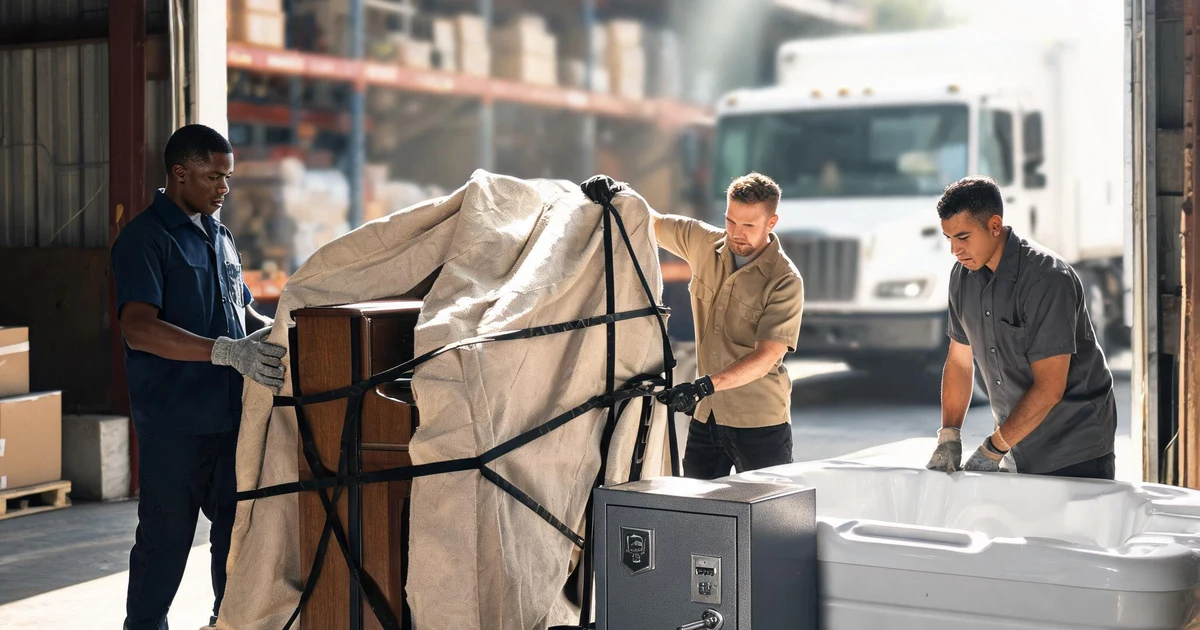
Your estimate template has a line for "stairs." It probably doesn't have one for "grand piano" or "$40,000 wine collection," which is exactly why these jobs turn into arguments. Specialty and high-value items aren't priced wrong because your crew doesn't know how to move them. They're priced wrong because nobody wrote down the rule before moving day, and an unwritten rule is not a rule a customer has to accept.
What Actually Makes an Item "Specialty" Instead of Just Heavy?
Two different things get lumped together as "specialty items," and they need two different pricing responses. The first is equipment-and-labor risk: pianos, gun safes, hot tubs, pool tables, and safes that need dollies, ramps, extra hands, or disassembly you don't do on a normal three-bedroom job. The second is liability risk: items that are small, light, and easy to carry but worth far more than their weight suggests — jewelry, fine art, rare instruments, collectibles. Federal regulation actually gives this second category a name and a number: a high-value article is anything valued at more than $100 per pound (49 CFR Appendix A to Part 375). A piano can trigger both categories at once — it's heavy enough to need special handling and often expensive enough per pound to qualify as high-value. Treating both risks as one line item ("specialty fee: $150") is how movers end up eating costs they never priced for and disputes they can't win.
What Does Federal Regulation Actually Say About These Items?
The same regulation that defines high-value articles also defines the surcharge you're already charging, whether you've labeled it correctly or not. Under 49 CFR Appendix A to Part 375, "Accessorial (Additional) Services" are explicitly defined to include "packing, unpacking, appliance servicing, or piano carrying, that you request to be performed or are necessary because of landlord requirements or other special circumstances." Piano carrying isn't a gray area you're inventing a fee for — it's a named accessorial service in the same federal rule that governs stair charges ("Flight Charge — An additional charge for carrying items up or down flights of stairs") and shuttle fees. That matters because a written estimate that doesn't list it as a disclosed accessorial charge is the same defect the accessorial-charges pricing guide already covers for stairs and long carries — undisclosed fees don't survive a dispute, regardless of category.
The separate high-value-article rule works differently. It's not about what you charge, it's about what you're liable for. Under Released Value Protection, the FMCSA caps your liability at $0.60 per pound per article by default (FMCSA Liability & Protection). For a 400-pound upright piano worth $8,000, that's $240 of coverage on an $8,000 instrument if something goes wrong — a gap that becomes your problem the moment a customer disputes the payout, not the mover's advantage it might look like on paper. The rule is specific: the mover's liability for "extraordinary value" items is limited *unless the customer specifically identifies them in writing before loading* (FMCSA). That written identification is the entire game. Get it before the truck is loaded, or the protection gap is yours to argue about after.
How Should You Actually Price These Jobs?
Consumer cost guides give you a useful floor to check your own pricing against, even though the number you actually charge should come from your own labor and equipment cost, not a national average. Angi's 2026 cost data lists typical ranges for the items that come up most often: a piano move runs $260 to $580, a hot tub $300 to $1,200, a pool table $375 to $1,500, a gun safe $200 to $525, and a standard safe $175 to $500 (Angi, "How Much Do Movers Cost?", updated July 2026). The spread in each range is the tell: a piano move at the bottom of that band and one at the top are not the same job, and the difference is almost always stairs, distance from the truck, and whether the piece needs disassembly — the exact variables your written estimate should be pricing explicitly, not folding into a flat "specialty fee" that doesn't hold up when a customer asks why it's $580 instead of $260.
Build your own rate card around three variables instead of a single number: base handling fee for the item category, a per-flight or per-obstacle surcharge (the same logic as your existing stair-carry fee), and a disassembly/reassembly charge when applicable. A moving company with a pricing rules engine can apply this automatically — DriveSales' estimating tools let you set stair carries, long walks, piano surcharges, packing fees, and minimums centrally, so every estimator quotes the same specialty-item math instead of guessing on the spot. That consistency is what actually prevents the dispute: a customer who sees "piano surcharge: $180 (per rate card, includes 1 flight)" on the written estimate has no ground to stand on later. A customer who was told a number verbally on move day does.
What Happens If You Skip the High-Value Declaration Paperwork?
This is where movers lose money without realizing it, because the mistake looks like it protects them and does the opposite. If a customer doesn't declare a high-value item in writing and something happens to it, your liability is capped at that $0.60/lb rate — which sounds like a win until the customer disputes the tiny payout, escalates, and you're now defending a decision you never actually documented. The high-value inventory declaration is a one-page form attached to the bill of lading: item description, quantity, declared value, both signatures, before loading. It costs you nothing to ask for it and it converts an argument about "what my grandmother's ring was really worth" into a signed record both sides agreed to. Skipping it doesn't reduce your risk. It just means the dispute happens without documentation instead of with it.
How Does Valuation Coverage Change the Math on These Jobs?
Full Value Protection is where you turn liability exposure into upsell revenue instead of just risk you're carrying for free. FVP typically runs around 1% of the declared shipment value, with deductible tiers at $0, $250, $500, and $1,000 that let a customer trade a lower premium for a higher out-of-pocket if something goes wrong. On a shipment with a $15,000 piano and a $10,000 gun safe collection declared, that's a real conversation to have at the estimate stage, not an afterthought at delivery: "You're covered for replacement value on these two items specifically, here's what the extra protection costs, here's what you're on the hook for without it." Customers moving anything they've flagged as high-value are, by definition, telling you it matters to them — that's the moment to sell the coverage, not the moment to hope nothing goes wrong and hurry through the conversation.
Frequently Asked Questions
Is a piano surcharge a legitimate, disclosable fee?
Yes. "Piano carrying" is explicitly named as an accessorial service under 49 CFR Appendix A to Part 375, in the same category as packing and appliance servicing. It needs to appear on the written estimate the same way a stair-carry fee does — the fee itself isn't the risk, an undisclosed fee is.
What qualifies as a high-value article?
Anything valued at more than $100 per pound under FMCSA rules — jewelry, fine art, antiques, rare instruments, and collectibles are the common examples. A 2-pound item worth $500 easily qualifies ($250/lb); a 100-pound piece worth $2,000 does not ($20/lb). Weight, not sentimental value, decides it.
Do we have to ask customers if they have high-value items?
No — under FMCSA rules, declaration is the customer's responsibility, not something movers are required to solicit. But asking anyway, at the estimate stage, protects you: it surfaces items you'd otherwise find out about after something goes wrong, and it opens the Full Value Protection conversation while there's still time to sell it.
What's the real cost difference between Released Value and Full Value Protection?
Released Value pays $0.60 per pound per article regardless of what the item was worth — a 15-pound gun safe insert worth $2,000 would net $9. Full Value Protection pays replacement value, repair, or a cash settlement at current market value, typically for a premium around 1% of the declared shipment value. For anything a customer has flagged as high-value, that gap is the whole reason FVP exists.
Should specialty-item pricing be a flat fee or itemized by job?
Itemized. A flat "specialty fee" can't explain itself when a customer asks why their bill is higher than a neighbor's. A rate-card approach — base handling fee, stair/obstacle surcharge, disassembly charge — gives you a number you can defend line by line, the same discipline recommended for accessorial charges like stairs and long carries generally.
---
Specialty and high-value items don't have to be the jobs your team dreads pricing. With the surcharge disclosed in writing, the declaration form signed before loading, and the valuation conversation happening at the estimate instead of after a claim, they become some of the highest-margin work you book. See how DriveSales' estimating tools apply your rate card automatically — piano surcharges, stair carries, and high-value declarations built into every estimate your team sends — or book a demo to see it running on your own rate structure.