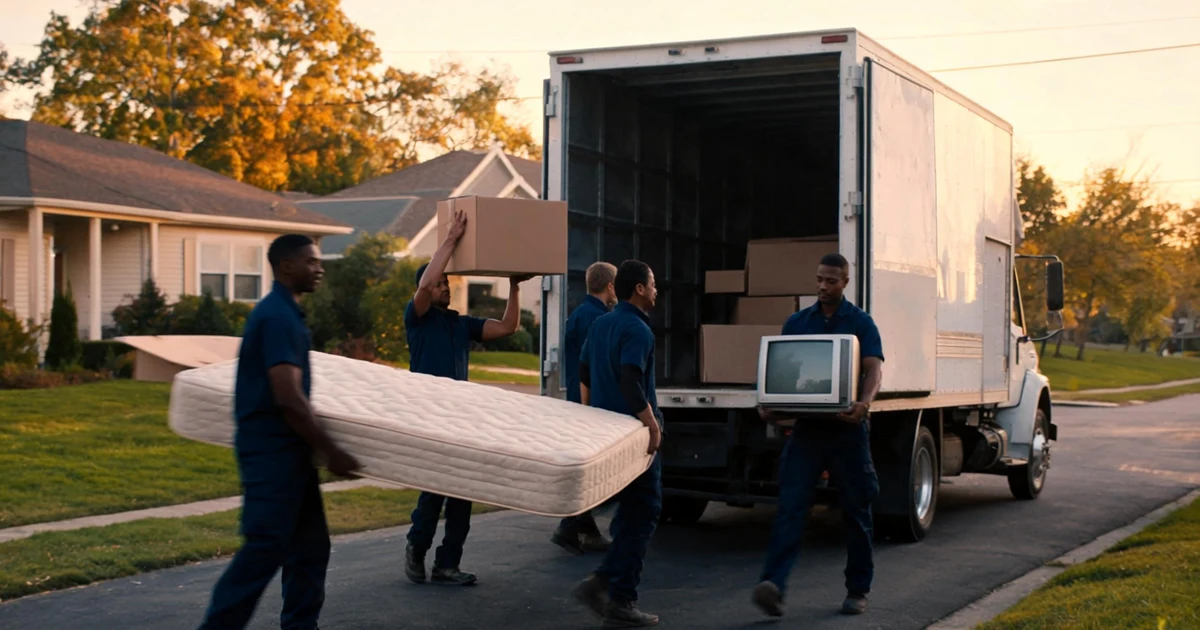
A customer books a move and asks if you can just take the old couch to the dump while you're there. You say yes because it feels like an easy add. Six months later you're running a second truck route to the landfill, eating tipping fees you never priced into the job, and your crew is spending an extra hour on move day that nobody billed for. Junk removal rides on the same trucks and the same customer relationships as moving, and it's one of the few add-on service lines that doesn't require a new sales channel to sell. It also has its own cost structure, its own insurance questions, and its own licensing layer that a straight household move doesn't carry. Here's what it actually costs to run and what it needs to earn before it's worth building out as a real line item instead of a favor.
How Big Is the Junk Removal Opportunity, Really?
Big enough that it's not a side hustle anymore. The broader waste collection industry that junk removal sits inside is a $83.1 billion market in the US in 2026, growing at a 2.1% compound annual rate since 2021 (IBISWorld, Waste Collection Services in the US). The residential and light-commercial hauling segment specifically — the piece that overlaps with what a moving company's crew and truck can actually do — rides the same demand drivers as moving itself: downsizing, renovation, estate cleanouts, and turnover between tenants, none of which slow down the way discretionary retail spending does in a soft economy.
The consumer-facing numbers back up why customers ask for it in the first place. Professional junk removal averages $241 per job nationally, with most jobs falling between $60 and $700+ depending on volume and item type (Angi, How Much Does Junk Removal Cost?). A full truckload runs $600-$800. That's real revenue sitting on top of a move you're already booking, if you price it as its own service instead of throwing it in for free because saying no feels awkward.
What Does Junk Removal Actually Cost You to Deliver?
Three cost buckets matter, and they're different from your core moving costs.
Disposal fees. Every load you haul away has to land somewhere, and landfills charge for it. The national ton-weighted average tipping fee is $57.63 per ton, but it varies sharply by region: $43.18/ton in the Southeast versus $84.44/ton in the Northeast (EREF, Analyzing Municipal Solid Waste Landfill Tipping Fees). A single full truckload of mixed junk can weigh a couple of tons, so disposal alone can run $100-$200+ per load before you've paid a crew member anything. Skip this line in your pricing and you're subsidizing every job.
Crew labor. There's no moving-industry-specific BLS wage code for junk hauling, so the closest public proxy is the Refuse and Recyclable Material Collectors occupation: a national median hourly wage of $22.00 (national mean $22.99), and $23.20/hour specifically within the Waste Collection industry (BLS OEWS, Refuse and Recyclable Material Collectors). Add your standard payroll burden (taxes, workers' comp, benefits, typically 20-30% on top of base wage) to get a real delivered labor cost, the same math you'd already run for a packing or storage add-on.
Insurance. This is the line most movers underestimate. A dedicated debris-removal general liability policy carries a median premium of $138/month, with a business owner's policy running $125/month, workers' comp $175/month, and commercial auto specifically for hauling work $268/month (Insureon, Debris & Junk Removal Insurance Costs). You may already have general liability and commercial auto for the moving side of the business — the question to take to your broker is whether that existing policy actually covers hauling and disposing of a customer's discarded property, or whether it needs an endorsement or a separate line specifically for the junk-removal work. Don't assume your moving GL policy silently extends to a different service.
Do You Need a Different License to Haul Junk?
Not a different federal authority — your FMCSA USDOT number and, for interstate work, your MC number cover the transportation piece the same way they do for household goods. What's different is local: many cities and counties require a separate municipal waste-hauler permit specifically for hauling and disposing of solid waste, on top of whatever moving authority you already hold. New York City requires a Trade Waste Removal License to remove, collect, or dispose of trade waste from businesses (NYC.gov, License for Waste Removal), and San Antonio requires a Commercial Solid Waste Hauler Vehicle Permit for anyone hauling commercial solid waste within city limits (City of San Antonio, Private Haulers: Permits & Information). Requirements vary by city and county, sometimes by neighborhood dumping-site rules — check with your local government before you advertise junk removal, not after your first load gets flagged at the transfer station.
Pricing It So It Actually Makes You Money
Anchor to what the market already pays, then subtract your real delivered cost, the same discipline behind every other service-line decision in this series. Angi's cost table breaks pricing down by load size: an eighth of a truckload runs $75-$125, a quarter load $125-$200, a half load $200-$400, and a full truckload $600-$800. Price by volume, not by a flat "we'll haul it away" number that doesn't account for how much space and disposal weight a job actually consumes.
Run the same formula you'd use for packing or storage: (crew labor cost × burden multiplier × hours) + disposal fee + insurance allocation = your delivered cost. Compare that against the market range above, and you'll know your real margin instead of guessing at a round number that feels fair. If a job is mostly bulky furniture or appliances, price closer to the top of the range — those items take longer to load and often carry their own disposal surcharges (major appliances commonly run $60-$250 to dispose of on their own, per the same Angi breakdown).
Should Junk Removal Ride the Same Job, or Get Scheduled Separately?
Depends on volume and truck capacity. A single couch or mattress pickup at the end of a move can usually ride the same truck and crew if you've priced and disclosed it as its own line item upfront — same logic as offering packing as an add-on at the point of estimate rather than as a day-of surprise. A full-house cleanout or a job with multiple large appliances usually needs its own dedicated run: a separate truck, a separate crew slot, and its own disposal-fee accounting, because trying to cram it into an already-scheduled move truck eats capacity you needed for the actual move.
This is a scheduling and capacity decision your dispatch board needs to be able to see clearly — a junk-removal add-on that silently rides a move slot without its own line item on the day's schedule is how a "quick favor" turns into a crew running two hours over on moving day with nobody having planned for it. Track your junk-removal attach rate the same way you'd track booking rate: a real number in your reporting dashboard, not a hunch about how often customers say yes.
Is Junk Removal a Different Enough Business to Need Different Software?
Not different software, but it does need to show up as a real, trackable service rather than a verbal yes on move day. That means junk removal appears as its own disclosed line item on the estimate with its own pricing (by load size, the same way packing and storage get priced as their own accessorial items), and your reporting can actually tell you the attach rate and margin on that specific line instead of burying it inside total move revenue.
If you're already running junk removal as your primary business rather than an add-on to moving, the calculus is different — see what to actually look for in junk removal business software for that comparison, and how to start a junk removal business from scratch if you're building the reverse direction, a hauling operation that later adds moving. For an existing mover adding junk removal as a second line, DriveSales' junk removal solution covers the specific feature set that maps onto hauling: photo-based estimating for quoting without a walkthrough, crew dispatch that can see a junk-removal slot as its own scheduled job, and reporting that separates junk-removal revenue and margin from your core move revenue instead of mixing them together.
Run the numbers on what a junk-removal line would need to generate before committing crew hours and a truck slot to it, and compare that against what a flat-fee CRM plan costs once junk removal, packing, and storage are all itemized and tracked automatically instead of re-typed by hand from a paper ticket.
Frequently Asked Questions
Do I need a separate business license to add junk removal to my moving company?
Your FMCSA USDOT/MC authority covers the transportation piece the same way it does for household goods moves. What's usually different is a local municipal waste-hauler permit — many cities and counties require one specifically for hauling and disposing of solid waste, on top of your existing moving authority. Requirements vary by city and county, so check with your local government before advertising the service.
How much should I budget for insurance before adding junk removal?
Talk to your broker about whether your existing general liability and commercial auto policies actually extend to hauling and disposing of a customer's discarded property, since that's a different risk than transporting their belongings intact. As a market baseline, dedicated debris-removal general liability policies carry a median premium of $138/month and commercial auto for hauling work runs a median of $268/month.
What's the biggest cost movers forget to price into a junk removal job?
Disposal fees. Landfill tipping fees average $57.63 per ton nationally but swing from $43 to $84+ per ton by region, and a full truckload can weigh a couple of tons. Quote the job without pricing in disposal and you're subsidizing every hauling job out of your own margin.
Can one crew and one truck handle both a move and a junk removal job the same day?
For a small pickup, like one couch or mattress at the end of a move, usually yes, if it's priced and scheduled as its own disclosed line item upfront. A full-house cleanout or multiple large appliances usually needs its own dedicated truck and crew slot, since cramming it into an already-scheduled move eats the capacity you need for the actual move.
Is junk removal worth adding if I only get a few requests a month?
Track it the way you'd track any add-on: revenue and delivered cost (labor, disposal, insurance allocation) specifically for junk-removal jobs, separate from your move revenue. If the margin doesn't clear your target after those real costs, either the pricing needs to move or the volume isn't there yet to justify the operational overhead of running it as a formal service line.